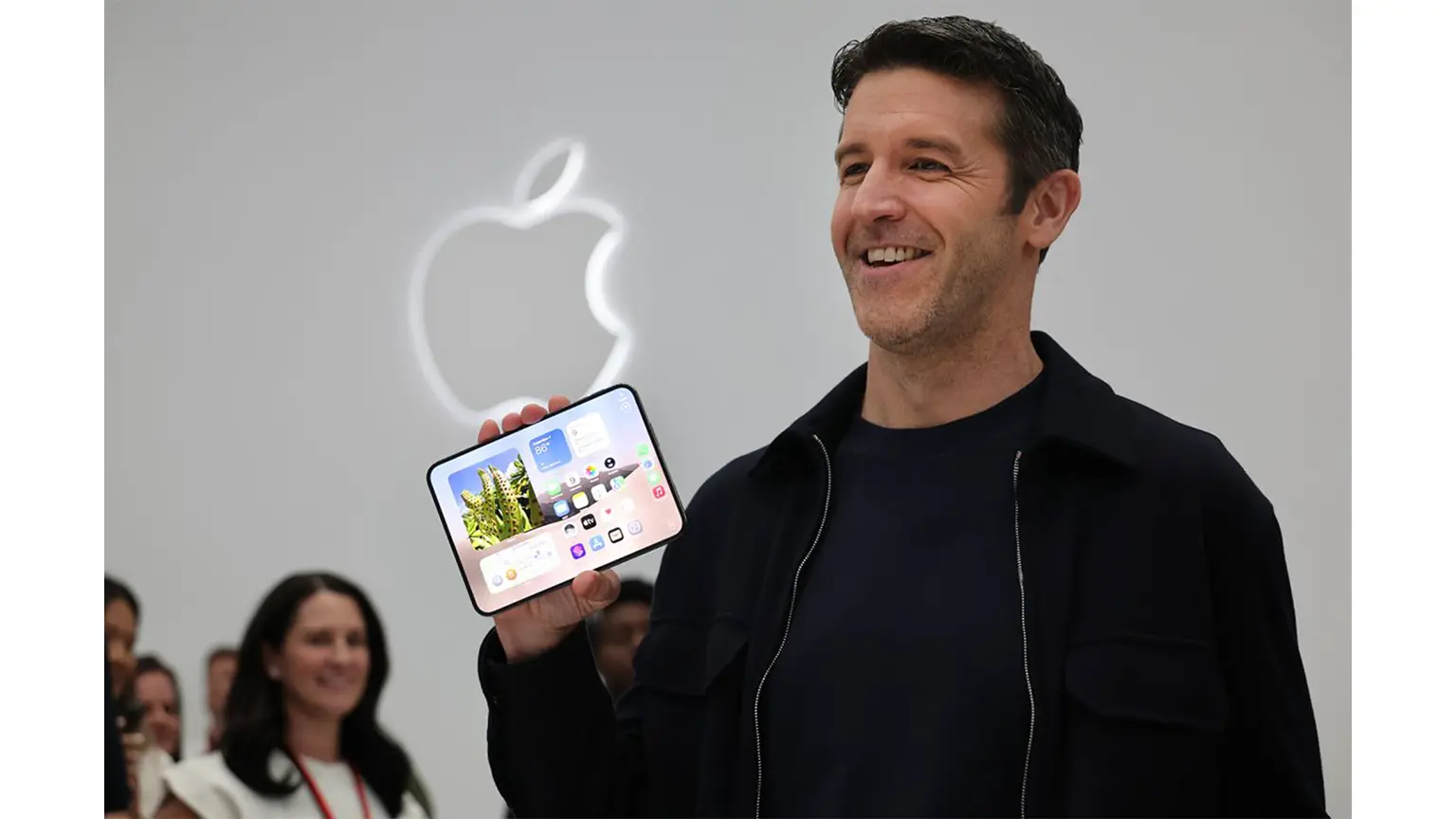
Yesterday, September 9, Apple held its annual September event titled “Surprise and Shine.” The title proved apt for two reasons. First, after years of teasers, the company finally unveiled its first foldable iPhone. Second, for the first time since 2011, the year’s most important launch was hosted by someone other than Tim Cook.
Below, we present the new hardware and software announced at the event.
iPhone 18 Pro and iPhone 18 Pro Max – an evolution powered by the A20 Pro chip
The core of this year’s smartphone lineup is the iPhone 18 Pro and the iPhone 18 Pro Max. Externally, little has changed compared to last year’s models, but on the inside, Apple has introduced a new generation of chips.
A20 Pro Chip
- Manufactured using a 2-nanometer process,
- A 6-core processor with integrated neural accelerators, featuring two new “super cores” (20 percent faster) and four new efficiency cores,
- A 7-core graphics processor described as being up to 40 percent faster than the previous A19 Pro chip,
- 50 percent more memory bandwidth compared to the A19 Pro,
- Neural Engine with 32 cores,
- The new steam chamber, with three times the surface area, is designed to dissipate heat more effectively during prolonged operation at high capacity.
Pre-sales of the devices begin on September 12, and sales begin on September 18, 2026.
Camera and battery
The Fusion’s main camera now has 48 megapixels and a variable aperture controlled by six blades, and users have manual control over the aperture, shutter speed, and white balance. Apple’s new Reference Image feature digitally signs sensor data to verify the authenticity of a photo (though, as noted on one of the slides, it will not be available in the European Union or China at launch). A similar restriction applies to the new AI-powered Siri, as discussed below.
The battery in the Pro Max model is rated for up to 45 hours of video playback, and the fastest charging option can recharge half the battery in about a quarter of an hour. Both models support eSIM only and feature the new C2 modem and N1 wireless chip with support for Wi-Fi 7, Bluetooth 6, and Thread.
The iPhone 18 Pro is available in black, silver, blue, and burgundy, with storage capacities ranging from 256 GB to 2 TB.
The iPhone Duo – the one Apple made us wait the longest for
It was the true “aha” moment of this event. After years of speculation, Apple unveiled its first foldable phone—the iPhone Duo. When unfolded, the device features a 7.6-inch Super Retina XDR display with a matte nano-texture finish, and when folded, it tucks away behind a 5.4-inch external display. Both screens support ProMotion and reach a peak brightness of 3,000 nits outdoors.
The front-facing selfie camera is hidden beneath the screen, giving the main display the appearance of a single, seamless sheet of glass without any cutouts. The new model also supports the Apple Pencil, making it one of the first iPhones compatible with the stylus.
The iPhone Duo will be available for pre-order on October 16 and will go on sale on October 23—a bit later than the rest of the lineup.
Apple Watch Series 12 and Ultra 4. More health data than ever before
While the watches haven’t seen a revolution in design, they have gained significantly enhanced health software. The Health app has been redesigned around a new “Longevity” tab, and one of the most interesting new features is the “Health Age” card—a metric that calculates your so-called biological age based on activity, sleep, and other parameters. In the example presented on stage, it was 26.1 years for a 30-year-old, meaning 3.9 years “ahead of schedule.” Apple did not, however, reveal the exact methodology behind the calculations.
Added to this is the “Readiness” feature, which provides a daily assessment of your body’s readiness for exercise, personalized training suggestions in the “For You” section, and the new “Audio Intelligence”—a feature designed to help you recall snippets of conversations and daily plans. The watches also feature Sound Recognition, which automatically alerts you to ambient sounds such as sirens or alarms, and a new sensor system measures your heart rate every five seconds—60 times more frequently than before.
Both models, along with the rest of the announced devices, will hit stores on September 18, and pre-orders have just begun.
AirPods 5 – Active Noise Cancellation Without Blocking Your Ears
The new AirPods 5 retain the open-ear design but, for the first time in this format, offer active noise cancellation, which Apple advertises as “the best ANC in an open-ear design.” The earbuds block out 50% more noise than the previous generation with ANC, and battery life with noise cancellation enabled has been extended to five hours. That’s one hour longer than with the AirPods 4. With the charging case, listening time reaches 22 hours.
The earbuds also feature Adaptive Audio mode, conversation awareness, live translation, voice isolation, and camera and volume control via a swipe gesture on the earbud. They’re also IP57-rated for dust, sweat, and water resistance and support hands-free Siri AI. Sales will begin on September 18, and they are already available for pre-order.
Siri AI and Apple Intelligence. A new Siri, but not for all markets
Apple devoted a lot of time to the new generation of Siri, referred to as “Siri AI” in the slides. The company boasted 2.5 billion queries per day and demonstrated the assistant’s everyday uses—from adding recipe ingredients to a shopping list, to notifications about changes on a tracked website, to recognizing scenes in photos using visual intelligence.
Siri AI will be available to users with the iOS 27 beta starting September 14, initially only in English. French, Japanese, Korean, Portuguese, and Spanish will be added in October. However, the company noted in a footnote that the new Siri will not be available in the European Union or China at launch—the same restriction that applies to the previously mentioned Apple Reference Image feature in the camera.
iOS 27 will be available on compatible devices on Monday, September 14, as a free update.
A Few Words About John Ternus’s Debut
This was the first time John Ternus hosted a keynote as the face of the entire company, rather than as the head of the hardware division presenting a single product. He welcomed guests live at the Steve Jobs Theater with a standing ovation, reflecting on his 25 years at Apple. The rest of the presentation followed the tried-and-true format.
The real “surprise” came at the end, when the audience was already convinced that the surprises were over. Ternus paused before leaving the stage and unveiled the iPhone Duo, bringing the entire presentation full circle. In terms of content, he followed in his predecessor’s footsteps, emphasizing privacy and on-device data processing as advantages over the competition. The debut was confident and well-directed, with a strong emphasis on the finale, even though the products had been developed during Cook’s tenure..