
During the Polish Security Congress, which took place on May 25–26, 2026, in Rzeszów, the “Diamond Shields” Gala was held.
The “Diamond Shields” competition is a unique event designed to honor and recognize outstanding achievements, innovation, and commitment in the field of national security and defense. This prestigious award brings together leading experts, leaders, and innovators who contribute to strengthening national security, raising safety standards, and advancing modern defense technologies. The competition also celebrates civic engagement and strategic initiatives aimed at promoting the country’s stability and resilience in the face of contemporary threats.
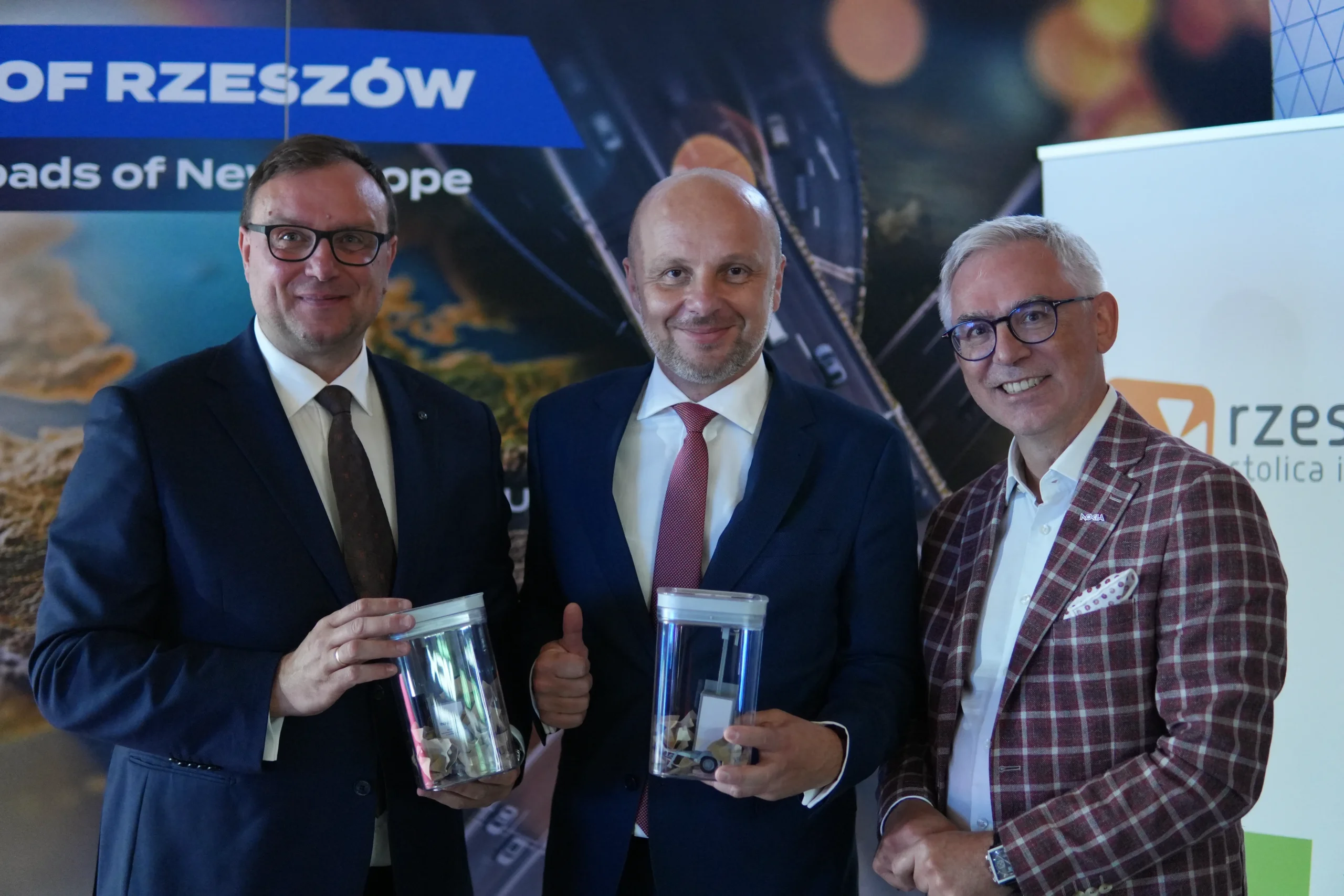
During the Grand Gala on May 25, 2026, Konrad Fijołek—the mayor of Rzeszów—was among those who received the Diamond Shield, in recognition of his concept for a comprehensive, fully autonomous Emergency Communications System compliant with the 3GPP standard. This system is an innovative solution that sets new safety standards on a national scale.
Instead of relying on commercial networks that are susceptible to outages or deliberate disruption, Rzeszów decided to build its own multi-layered connectivity ecosystem. The system integrates advanced technological components. A mobile base station for a private fifth-generation cellular network, equipped with a telescopic mast, can create an independent “connectivity island” in just a few minutes.
Satellite communications ensure access to a global network even after ground infrastructure has been destroyed. The MCX command and control platform transforms rugged smartphones into radios with encryption and the ability to track rescue workers. Video feeds, including those from drones, provide live footage to the command center.
An IoT sensor network provides early warnings by monitoring water levels, weather, and air quality.
Rzeszów is proving that local government can be a true leader in innovation in crisis management by developing a safety model that other Polish cities can and should replicate.
INNERGO received the award for designing and implementing the Emergency Communications System (SŁA) in accordance with the 3GPP standard; Paweł Panasiuk, Vice President of the Management Board, accepted the award on behalf of the company. He was accompanied by Kinga Piecuch, President of the Management Board of Hewlett Packard Enterprise Poland, and Paweł Niedzielski, Sales Director at Nokia Poland.
The Emergency Communications System was developed using private 5G network solutions provided by HPE and Nokia.
A modern emergency communications system compliant with the 3GPP standard will enhance the safety of residents and the efficiency of emergency services in Rzeszów
Extreme weather events, infrastructure failures, and threats related to armed conflict are increasingly putting security systems to the test. At such times, public telecommunications networks can become overloaded or completely unavailable, making it difficult to maintain contact and coordinate rescue operations.
The City of Rzeszów has decided to implement a modern Emergency Communications System, which will significantly improve the effectiveness of emergency response services and, as a result, enhance the safety of residents. Based on a private 5G network, the Emergency Communications System is designed to ensure reliable communication during crises when traditional communication methods may fail.
The solution developed by INNERGO in collaboration with HPE and Nokia ensures reliable and secure transmission of sensitive data, user mobility, and the flexibility needed to operate in rapidly changing crisis situations.
The implementation of the Emergency Communications System is a step toward modern crisis management, in which new technology provides tangible support to first responders who protect the lives and health of residents. The solution, based on a private 5G network, will ensure reliable and secure communication even when standard communication channels fail. The system will enable efficient data exchange, coordination of field operations, and rapid decision-making in high-risk situations.– Tomasz Wolanin, Sales Director at INNERGO, highlights the key benefits.
Your own next-generation network; no risk of overload
The system is based on a private 5G network in Standalone (SA) mode, utilizing a frequency band dedicated to local government units. Unlike public cellular networks, this solution is fully isolated and dedicated exclusively to operational purposes. It ensures stable data transmission and prioritizes connections for emergency services, which is crucial during high-risk operations.
The main subsystems of the 5G network are: the network core (5G Core) provided by HPE and the RAN (Radio Access Network) solution provided by Nokia. The network core consists of fixed infrastructure, primarily servers and software for managing the network and controlling its operations, while the RAN comprises 5G base stations and antennas that provide coverage throughout the city.
We are pleased to be carrying out this project with INNERGO, a company with 100% Polish capital — an integrator with extensive experience in this type of implementation in Poland — notes Kinga Piecuch, CEO of HPE Poland – This is also an example of a project that demonstrates how cities can collaborate with a systems integrator capable of leveraging solutions provided by companies such as HPE.
Just a few years ago, private 5G networks were primarily associated with industrial digitization. Today, they are increasingly becoming part of critical infrastructure, enhancing cities’ resilience to crises. Rzeszów is the first city in Poland to decide to use this technology to build its own independent communications system for the services responsible for the safety of its residents. Equally important, this same infrastructure can support the city’s day-to-day operations and improve the quality of life for its residents. We believe this is a direction that will become the standard for modern crisis management in the coming years –says Piotr Kankiewicz, Sales Director at Nokia Solutions and Networks.
Rzeszów is reaffirming its position among the most innovative cities in Poland, which are implementing new technologies to enhance the safety and quality of life for residents and improve the efficiency of municipal services. Our experience with numerous installations around the world shows that such solutions not only deliver immediate, intended results but also open up entirely new possibilities for utilizing the city’s own 5G broadband mobile network – adds Paweł Niedzielski, Sales Director at Nokia Solutions and Networks.
Mobility and Field Work
An autonomous component of the emergency communications system is a mobile 5G network—installed on a vehicle trailer—that can be moved to any location to provide temporary communications there. Equipped with its own power sources (solar panels and a generator) and a telescopic antenna mast, it can be quickly transported and deployed in areas lacking telecommunications infrastructure, such as regions affected by natural disasters.
This component of the Emergency Communications System was designed by INNERGO and is based on a complete Nokia solution. The mobile 5G network—the Nokia Perimeter Network—deploys within minutes, providing broadband connectivity where it has suddenly been lost. The system consists of a portable 5G SA Core and a radio network which, thanks to its own off-grid power supply and antennas, creates a 5G “connectivity island” anywhere and at any time.
Environmental Monitoring and IoT
The Emergency Communications System implemented in Rzeszów provides not only voice communication but also advanced data analytics. Thanks to the use of IoT (Internet of Things) technology, sensors will be deployed at critical locations to monitor, among other things, water levels, weather conditions, and air quality. This data will be transmitted in real time to the management center, enabling early warnings of hazards such as floods or smog.
Thanks to their own independent network, firefighters and paramedics have priority access to communication channels. It’s as if a digital highway had been built just for them, one that no one else can access. As a result, for example, footage from a drone circling above a fire scene reaches the commander in a fraction of a second, in the highest quality. This allows for decisions to be made that save lives before a tragedy occurs – notes Tomasz Wolanin, Sales Director at INNERGO.
Data and Personnel Security
The communication platform provides end-to-end encryption for calls and video streams, as well as employee safety features such as geolocation and “Lone Worker” alert systems. The entire server infrastructure is based on high-performance computing units, ensuring smooth system management even under maximum load.
“Heavy-duty” equipment for users
Rescue workers and firefighters will be equipped with extremely durable devices. These will include laptops and phones that are resistant to water, dust, and drops from heights (and that meet military standards, among others). This will allow them to focus on completing their tasks without worrying about potential damage. Nokia’s specialized industrial-grade phones (with reinforced construction and durability) will enable the use of advanced features and apps typical of modern smartphones in all conditions—during rescue operations and other field activities.
Niezawodność i wsparcie techniczne
Z uwagi na krytyczny charakter systemu, INNERGO zapewnia najwyższej jakości usługi serwisowe w rygorystycznym reżimie obsługi. Infrastruktura będzie objęta całodobowym wsparciem technicznym przez 365 dni w roku. W przypadku wystąpienia awarii krytycznej, czas reakcji serwisu wynosi zaledwie 4 godziny, co gwarantuje bezpieczeństwo działania systemu w każdych warunkach.
Wdrażany przez INNERGO, we współpracy z HPE i Nokia, System Łączności Awaryjnej dla miasta Rzeszowa to jedno z najbardziej zaawansowanych rozwiązań mobilnej łączności prywatnej w kraju. Zastosowanie standardu 5G Standalone oraz technologii IoT pozwala nie tylko na błyskawiczną wymianę informacji, ale także na realne monitorowanie zagrożeń w czasie rzeczywistym. Dostarczamy kompletną, autonomiczną infrastrukturę, która jest w pełni odporna na przeciążenia publicznych sieci. W INNERGO od początku swojej działalności specjalizujemy się w realizacji bezpiecznych i niezawodnych systemów do transmisji danych wrażliwych i głosu – podsumowuje Paweł Panasiuk, Wiceprezes Zarządu INNERGO.